With an eight-week lead time, today’s order covers sales three months away: plan the container, not the shelf gap
For wholesalers and importers who bring goods in by container from Asia, Turkey or the Americas, with lead times of weeks and factory minimums, and sell to trade customers or to their own branches. We count what is in the warehouse, on the ship and on order, forecast each item until the next order can land, and tell you when to close the container and with what.
Book a 30-minute demoHow it works
Read-only connection · Tested on your own data first · Data hosted in the EU · Demos in English or Spanish
The short answer
Inventory planning for wholesalers and importers forecasts the sales of each item until the next order arrives, counts stock in transit on its real arrival date, and calculates when the next container must be confirmed and what to fill it with. It respects factory minimums and the variation in each supplier’s lead time, and splits each arrival between warehouses or customers. The buyer approves or changes every line. It connects read-only to your ERP.
By Manuel Gómez González, founder of Arume · Reviewed on
What it does
Stock in transit that counts
What is ordered from the factory, in production, shipped and waiting at the port. Each line has its estimated arrival date, updated when your forwarder changes it. We add that stock to the warehouse on the date it will really be available, not the day it was paid for.
When to close the next container
With each item’s forecast and the full lead time (production, transit, customs and unloading), we calculate the date by which you must confirm the order. You are warned weeks ahead, not when you are already short.
Filling the container sensibly
Factory minimums and container volume push buyers to fill with what fits. We propose filling with the items most likely to stock out before the next shipment, and show what each line means in weeks of cover. If the container falls short, we show what to bring forward and how much excess it creates.
Split between warehouses and customers
If you sell from several warehouses or serve large customers with regular orders, we split each arrival: what stays at the central warehouse, what goes to each branch, and which customers have a reservation. One sentence per line.
A cover panel in weeks
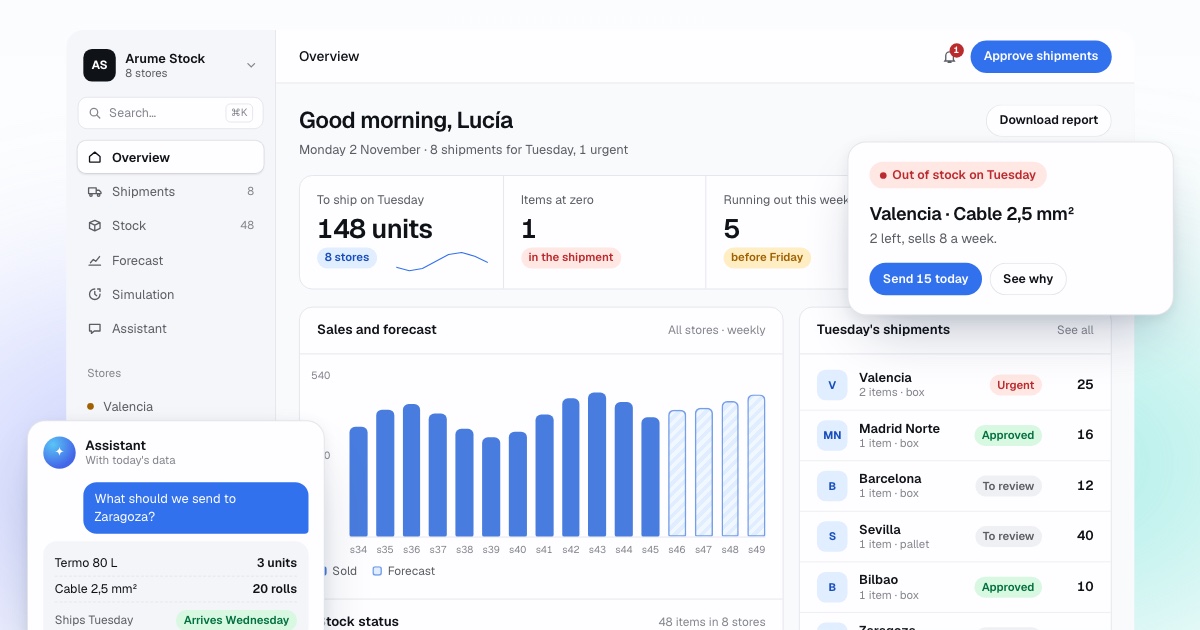
For each item, how many weeks the warehouse covers and how many the stock in transit covers, against the replenishment time. Out, running out, fine, excess. And the money tied up in the warehouse and at sea.
Ask it like you would ask your head of purchasing
“Do we last until the March ship with the 24 cm frying pans?” “What if the container is two weeks late?” The assistant does the sum with your data and says where each figure comes from.
How is the next container decided today?
In an importing wholesaler the factory order is decided by the buyer, often the same person for years. They look at warehouse stock, remember last season’s sales, add up in their head what is already on the way, and close the container when it feels right or when the factory warns that the production slot is ending.
With lead times of eight to fourteen weeks, a mistake takes months to show and cannot be corrected. Order short and the item hits zero weeks before the ship arrives, with air freight as the only fix. Order long and the warehouse fills with the item that did not sell, and the cash stays locked until next season.
The stock in transit usually lives somewhere else too: a container tracking sheet, the forwarder’s emails, or purchase orders in the ERP with dates nobody updates. It exists for the accountant but not for the purchasing decision.
What is stock in transit and why does it change the calculation?
Stock in transit is goods you have ordered that are not yet in your warehouse: in production, shipped, at the port or in clearance. In importing it can be as large as physical stock, and a replenishment calculation that ignores it orders the same thing twice or, the other way round, treats as arrived something that is a month late.
We add that stock to the forecast on the date it will really be available to sell. The question “will I last until the next ship?” is then answered week by week for each item and warehouse, and the deadline for confirming the next order appears by itself.
- Confirmed factory order: counts from the expected arrival date, with that supplier’s usual variation.
- Shipped: counts from the estimated port arrival plus clearance and unloading time.
- At the port or in a bonded warehouse: counts once cleared and delivered to your warehouse.
- If the forwarder changes a date, the calculation reruns and shows what runs out sooner.
What do minimum orders do to the plan?
The factory asks for a minimum per item or model and the container has a volume. Between the two, the buyer ends up filling with what fits, not what is needed. We propose filling with the items most at risk of running out before the next shipment, and show what each line means in months of cover.
When the minimum is far larger than sales, we put the cost first: how many months of stock it is and how much money it ties up. That figure is what lets you negotiate with the factory, pool items with another importer or discontinue with arguments.
Variants are the other hole. A factory that demands 600 units per model does not care whether they are white, black or red, so the buyer splits the minimum evenly or like last year. We split it using the sales of each variant in your warehouses and show, before you confirm, how many units of each colour will still be on the shelf when the next ship arrives. In cookware, home textiles or small appliances, that sum often explains a good part of the dead stock.
What does customs have to do with stock?
Under Article 77(1) of the Union Customs Code (Regulation (EU) 952/2013), a customs debt on import is incurred by placing non-Union goods liable to import duty into free circulation. Article 240 describes customs warehousing, where non-Union goods are kept in premises approved by customs authorities, under their supervision.
For inventory planning, what matters is time: how many days pass between the goods reaching the port or the bonded warehouse and being sellable. We measure that from your own receipts and add it to each supplier’s lead time. Customs clearance, duties and the declaration stay with your forwarder or customs agent, and the system does not replace them.
Which programs do importers use?
Business Central, SAP Business One and Sage are common in mid-sized importers, and Odoo in those that have grown recently. Almost all handle the purchase order and the supplier invoice well, and container tracking less well, because it tends to live in a separate sheet shared with the forwarder.
We connect to the ERP with a read-only user and read the container sheet as it is. The approved order goes back as a purchase order in your ERP or as a proposal for the buyer.
What do we need from your data, and what does it not do?
Sales per item, warehouse and date; stock per warehouse; supplier orders with confirmation, shipping and receipt dates; and container tracking if it exists. With that we measure real lead times and their variation, which weighs most in the calculation. One year shows the season, which in importing is often decisive.
It does not book freight or space on ships, handle customs or duties, or negotiate with the factory. It gives you the forecast, the deadline and the order proposal. The buyer decides.
How do you test it and how do you start?
We replay your last twelve months with what was known each week: when the system would have ordered each container, with which items, and what would have happened to actual sales. We compare that with what you did: weeks with items at zero, urgent air shipments, stock left at the end of the season. If it does not improve, we say so at that point.
Then one or two months in shadow mode, with the buyer deciding as always. Set-up takes three to six weeks. The way in is a 30-minute video demo, in English or Spanish.
Frequently asked questions
Our lead time is 10 to 14 weeks and varies a lot. Is that handled?
Yes. We measure each supplier’s and route’s real lead time from your past orders, from confirmation to goods receipt, and use its variation as well as the average. A supplier that takes 10 weeks one time and 15 the next needs more safety stock than one that always takes 12, and the calculation reflects that.
How do you record stock in transit?
With what you already have: purchase orders in the ERP with an expected date, the forwarder’s tracking sheet, or a list of containers with their contents. Each line needs an item, a quantity and an estimated arrival date. When the date changes, we recalculate.
The factory requires a minimum order per item. What do you do?
We respect it as a constraint and show its cost. If the minimum is 1,000 units and you sell 80 a month, you see how many months of stock that is and how much cash it ties up, so you can decide whether it pays or whether another item or supplier is better.
Can bonded warehouse stock be counted separately?
Yes. It is treated as one more warehouse, with its own stock and the time until it is available to sell, which is how long you take to clear it. We do not keep customs accounts for the bonded warehouse. We only count when that stock can go out to your customers.
Does it work if we sell to hundreds of trade customers rather than our own shops?
Yes. Forecasting is done per item and warehouse on the combined sales of all customers, and large customers with scheduled orders are treated separately. If you want to forecast per customer, that is possible for the ones that buy regularly.
What about new items with no sales yet?
They are forecast by similarity: we look for items of the same family, price and channel that have history and propose a first order from their range. After the first weeks of sales, the forecast switches to the item’s own history.