Ecommerce inventory forecasting: reorder each variant before the product page says sold out
For online stores with their own warehouse, or several, that buy from domestic suppliers and from overseas. We read your orders from Shopify or WooCommerce, forecast every size, colour and pack separately, and prepare the supplier order with its lead time, counting returns and the campaign that is coming. You approve it before it goes out.
Book a 30-minute demoHow it works
Read-only connection · Tested on your own data first · Data hosted in the EU · Demos in English or Spanish
The short answer
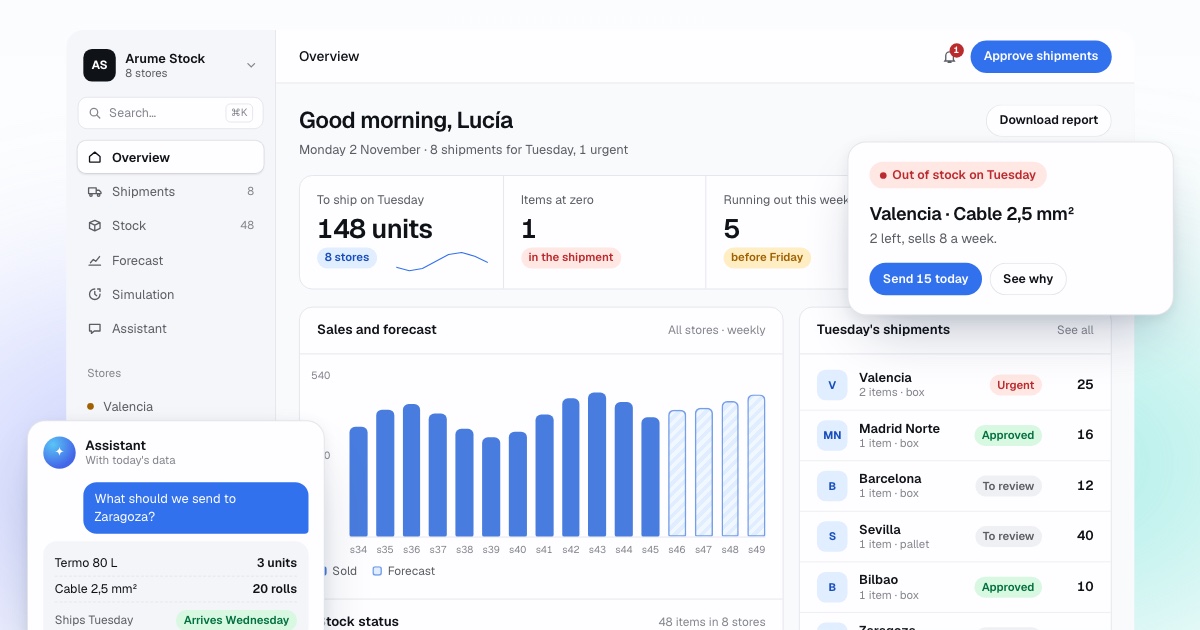
Ecommerce inventory forecasting calculates how much of each variant (size, colour or pack) to buy before the shop shows it as sold out. It reads orders and stock from Shopify or WooCommerce, counts each supplier’s lead time, returns that come back late and campaigns such as Black Friday, and drafts the purchase order with the reason for every line. It suits stores with their own warehouse that buy from domestic or overseas suppliers. A person approves each order.
By Manuel Gómez González, founder of Arume · Reviewed on
What it does
Reorder by variant, where stock really breaks
A hoodie can have forty units in the warehouse and still be sold out for half your visitors: there are XL in yellow and no M in black. We forecast each variant on its own, using the size and colour curve your shop actually sells, and propose the order line by line. A new variant borrows the curve of its siblings until it has history.
Campaign stock ordered when the supplier needs it
If an Asian supplier takes twelve weeks between production and unloading, Black Friday stock is decided in early August. We count back from each campaign with each supplier’s lead time, scale last year’s sales to this year’s growth, and tell you the date the order has to leave.
Returns as stock that comes back late
A returned order is not a sale that never happened, and it is not available stock the next morning. It reaches the shelf a week or two later, and not always in sellable condition. We learn what share of each product comes back and how long it takes, and we do not count it twice.
The days a product was out of stock
If a SKU was unavailable for ten days, it sold zero in those ten days. A spreadsheet or a store report reads that as weak demand. We rebuild stock day by day from orders, purchases and adjustments, mark the empty days and estimate what would have sold.
Supplier minimums and container fill
Some suppliers ask for a minimum per item, others only make sense if you fill half a container. We group proposals by supplier and, when a minimum has to be reached, complete it with the variants closest to selling out, not with whatever has the best margin or whatever someone remembers.
One count for the web shop and the marketplaces
If the same warehouse serves your site, Amazon and another marketplace, each channel has its own pace and its own reserved stock. We add them up per variant to see what is really free and forecast each channel separately.
How is ecommerce stock decided today?
In most online stores one person decides what to buy, usually the same person who runs the shop. The order is prepared on a Sunday night with the Shopify or WooCommerce admin open: sort by units sold, look at what is low, add a margin, send. It works while the catalogue is small and the supplier delivers in a week.
It stops working with variants. A store with 400 products and three sizes and four colours each has thousands of lines, and the platform’s low-stock alert is a fixed number set once, equal for the best seller and for the item that sells twice a month, in March and in November. Shopify itself describes store inventory as the number of each product variant you have available to sell, so the unit you are managing is the variant, not the product.
What does inventory forecasting add to a store’s own reports?
A report tells you what happened. A forecast tells you what you will need between now and the day the next order can arrive. That gap is the lead time, and it is what makes a low-stock alert useless: if your supplier takes ten weeks, an alert at fifteen units arrives when there is no solution left.
For every variant we work out how many days of sales you have left at the current pace and with the campaign ahead, and compare that with the supplier’s real lead time, measured from your past purchase orders. Only the lines that need an order appear on your list, sorted by what you lose if you do not place it.
How do you plan for Black Friday when last year’s best seller sold out?
The sales figure from last year is wrong for exactly the products that matter: the ones that ran out. We first estimate what would have sold had they not run out, marking the days with no stock. Then we scale that figure to how much the shop has grown, and separate what sold because of the discount from the base demand.
The result is a quantity per variant and a latest order date per supplier. For a ship that takes twelve weeks, that date is August, which is why the question is rarely “how much” and more often “by when”.
- Days out of stock marked and estimated, so the best seller is not under-forecast.
- Growth and discount effect separated from base demand.
- Order deadline calculated per supplier, with a warning weeks ahead.
- Lower confidence flagged on new collections with no history.
Which platforms and programs does it connect to?
Most of our ecommerce work starts from Shopify or WooCommerce, with PrestaShop as a third option, and often an ERP behind them such as Holded, Odoo or Business Central. We connect with a user that can only read. The approved order comes back as a draft purchase order, or as a spreadsheet you send to the supplier.
If you sell on your own site and on Amazon from one warehouse, orders are read per channel and forecast per channel, then added against the warehouse that serves them. Stock you send to Amazon’s warehouses is treated as another location with its own replenishment time.
Which consumer rule touches delivery and stock?
Article 18 of the EU Consumer Rights Directive (2011/83/EU) says that, unless you agreed otherwise with the consumer, a trader must deliver without undue delay and no later than 30 days after the contract is concluded. If a promised date is missed, the consumer can set a reasonable extra period and then terminate.
For stock, that means an item sold when it is not really available can turn into a cancelled order. A forecast that keeps the availability on the product page honest helps you meet that deadline. The obligation is your company’s, and your legal adviser should confirm how it applies to your shop.
What do we need from your data, and what does it not do?
Orders per variant, channel and date, preferably two years so a full peak season is visible; current stock per warehouse; purchase orders with order, shipping and receipt dates; and returns if you record them. One year is enough to start, with lower confidence flagged on each line.
It does not set prices, run your advertising or manage the supplier relationship. It does not decide for you either: you approve each line, and what you change is recorded, so the next proposal learns from it.
How do you test it before signing?
We replay your last season with what was known each week, with no knowledge of the future, and compare what the system would have ordered with what you ordered: stockouts, lost sales and money tied up. If it does not improve on your own decisions, we say so there.
After that, one or two months in shadow mode, where the system proposes every week and you keep ordering as usual. Only then does it go live. A 30-minute video demo, in English or Spanish, is the way to start.
Frequently asked questions
Shopify already warns me when stock is low. What does this add?
The Shopify alert fires when stock drops below a number you typed, and that number knows nothing about the season or the supplier’s lead time. We calculate, for every variant, how many days of sales remain at the current pace and with the coming campaign, and compare that with the time the next order needs to arrive.
I have thousands of variants. Can it cope?
Yes, and that is where it makes most sense, because nobody can review three thousand variants every week by hand. Slow variants are forecast using their parent product and the size curve, fast ones with their own history. Only the lines that need an order show up on your list.
How does it treat returns?
As a flow with a delay. For each product family we learn what share of sales comes back, how many days it takes to be back on the shelf, and what share cannot be resold. Forecast demand uses what customers keep, and available stock includes returns only when they can be sold again.
What happens with a new collection that has no history?
It is forecast from similar items in earlier collections: same family, price and launch period. The system marks that confidence as low. After two or three weeks on sale, real sales weigh more and the forecast adjusts. For the first buy it is often wise to order slightly less from the distant supplier and keep room to top up from a closer one.
Do you handle dropshipping or made-to-order items?
They are marked as items you do not hold and are left out of the purchase calculation. If one sells so well that holding stock would pay off, we flag it with the last months of sales in front of you.
Where is the data hosted, and can I leave?
In the EU, with daily backups. The connection is read-only, and if you stop working with us you can export everything.