The franchisee’s order is prepared at head office, and the franchisee approves it because the stock is theirs
For franchise head offices in food, fashion, home, beauty or restaurants that replenish franchisees and company-owned stores. Each store orders its own way: one too much out of fear, another too little because cash is tight, and head office finds out when there is a stockout or a return. We read each store’s till sales and prepare its weekly order with one sentence per line.
Book a 30-minute demoHow it works
Read-only connection · Tested on your own data first · Data hosted in the EU · Demos in English or Spanish
The short answer
Franchise inventory replenishment reads the till sales of each store and prepares a suggested order, with its reason, for every franchisee and company-owned shop. It suits head offices that replenish dozens or hundreds of stores. It adjusts the range to each store’s size and customers, starts new openings from the history of similar stores, and leaves the final decision with the franchisee, who pays for the stock.
By Manuel Gómez González, founder of Arume · Reviewed on
What it does
A suggested order for every franchisee
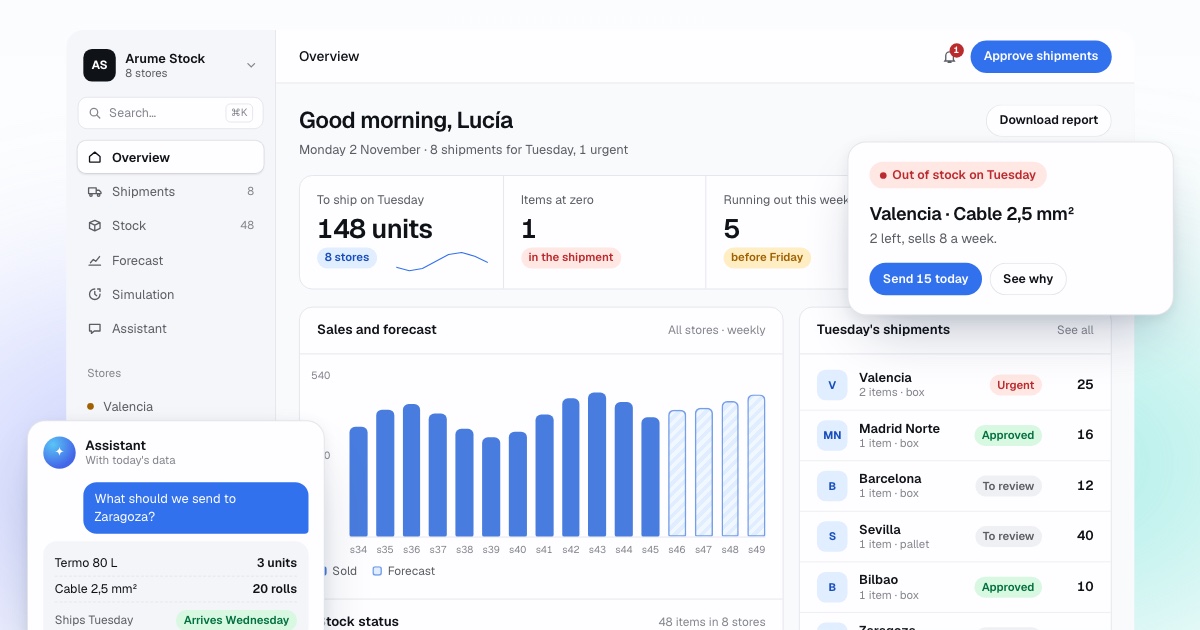
Each week every store receives its order already calculated from its sales, its stock and head office’s delivery calendar: what, how much and why (“you sell 14 bags of almonds a week and have 9 left; the next truck arrives on Thursday”). The franchisee accepts, changes or rejects it in their ordering portal. Changes are recorded, and the system learns from them.
Range by store, not one range for the network
A 40 square metre store on a through street does not sell what a 120 square metre one in a shopping centre does. We group stores by how they really sell (size, location type, customers, season) and propose which items deserve shelf space in each group. Head office sets the mandatory brand range; the rest follows what each store sells.
Openings that do not start blind
A new store has no history. We look across the network for the most similar stores by size, location and opening month, and build the first order and the first weeks from what they sold. From the first month, the store’s own sales take over and the forecast corrects itself.
Company-owned and franchised stores on one map
Head office sees both networks in one panel: which stores are out, which will run out of an item this week, which have stock that is not moving. For company stores the order can be approved at head office. For franchised stores the panel shows what was proposed and what the franchisee decided, so the area visit can start from data.
Transfers between stores
If one store is sitting on an item that sells in another, we flag it before more is sent from the warehouse. Whether to transfer is a decision for head office and the franchisees involved.
How is a franchise order decided today?
In most networks the franchisee places the order, by phone, email or a portal, from what they see on the shelf and what they fear running out of. A confident owner over-orders, a cautious one under-orders, and a franchisee short of cash trims the order to protect it. Head office sees the result late: a stockout reported by a customer, a return or an expiry.
Head office has something the single store does not: the sales of every other store. A suggested order is built from that. It does not replace the franchisee’s judgement. It gives them a starting point calculated with their own sales and the network’s history.
What is a suggested order in a franchise?
A suggested order is a proposal, calculated by head office, of what each store should order in the next cycle, with the reason for each line. It is built from the store’s sales, its current stock, the pack size and the delivery calendar. The franchisee can accept it in full, change lines or reject it.
That last point matters for the relationship. The stock is paid for by the franchisee, so the decision is theirs. What changes is the information they have when deciding. When the franchisee changes a line, we keep it and learn from it: if a store always cuts a certain item, the next proposal takes that into account.
How do you handle range in stores that look the same but sell differently?
The same sign hides very different stores. We group them by how they sell, not by how they are labelled: size, type of location, customers and season. For each group we show which items earn their space and which do not.
Head office keeps control of the mandatory range that defines the brand. Beyond it, each group of stores gets a recommended range, and a store that wants to try an item outside it can do so, with its sales then telling both sides whether it worked.
How do you start a new opening?
The first order of a new store is usually a guess, and it is expensive in both directions: too much stock ties up the new franchisee’s cash in the first months, too little loses sales when the store is most visible.
We look for the stores in the network most similar by size, location and opening month, and build the first order and the first weeks from what they sold. After about a month, the store’s own history takes over.
- Similar stores chosen by size, location type and month of opening.
- First order sized to the first weeks, with a quick review after week one.
- Confidence flagged as low until the store has its own sales.
Which programs does a franchise head office use?
Usually three layers: the till or POS network of the stores, an ERP at head office (Business Central, Odoo, Sage or SAP Business One are common) and spreadsheets for whatever neither covers. We read from them with a read-only user, with no need to change the till.
The suggested order goes back to the ordering portal or ERP as a draft, and the franchisee’s decision is recorded next to it.
How big is the franchise sector, and why does scale matter?
According to the Spanish Franchise Association (AEF), as reported by Emprendedores, Spain closed 2025 with 1,295 franchise networks and 77,526 operating outlets, of which 21,674 were company-owned and 55,852 franchised. A separate AEF, ICEX and Cajamar study counts 314 Spanish networks abroad, with 18,929 outlets in 139 countries.
Those are Spanish figures, but the point travels: once a head office replenishes dozens of stores, nobody can review each one every week, and small ordering errors repeat across the whole network.
What do you need from your data, what does it not do, and how do you test it?
Sales per item, store and day from the tills, stock per store if you have it (or a count we can start from), the delivery calendar and the pack sizes. With a year of history we can group stores and start forecasting.
It does not set the franchisee’s prices, decide who may open a store or replace the field team. We replay your last months with what was known each week and compare with what stores ordered, then run one or two months in shadow mode. The way in is a 30-minute video demo, in English or Spanish.
Frequently asked questions
Who decides the order, head office or the franchisee?
The franchisee. The stock is paid for by the store, so the system prepares a proposal and the franchisee accepts, changes or rejects it. For company-owned stores, head office can approve the order directly.
What if franchisees ignore the suggestion?
Their changes are recorded and visible to head office. If a store keeps cutting an item, the next proposal takes that into account, or head office can see it needs a conversation. Nothing is imposed by the system.
How does it work for a store with no sales history?
We take the history of the most similar stores in the network, by size, location type and opening month, and build the first order from it. Confidence is marked as low until the store has a few weeks of its own sales.
Do we need to change our till system?
No. We read sales from the tills or the central system you already use. If the stores run different tills, we agree one export format and start from there.
Does it work for restaurants and cafés in a franchise, or only retail?
For both. In food service the order follows covers, bookings and shelf life, so it uses the same logic as our restaurant group page, applied store by store.
Where is the data stored?
In the EU, with daily backups. The connection is read-only, and you can export everything if you stop working with us.