Stocky alternatives: what Shopify now covers, what it does not, and who fills the gap
Shopify’s Stocky app stopped being available on 31 August 2026. If you used it for purchase orders, transfers between stores or knowing what to reorder, you now have to decide whether Shopify’s own tools are enough or whether you need something else. Here is what Shopify says in its help centre, what merchants who migrate tend to miss, seven alternatives we checked one by one on their own websites, and where our own system fits and where it does not.
Book a 30-minute demoHow it works
Read-only connection · Tested on your own data first · Data hosted in the EU · Demos in English or Spanish
The short answer
Stocky, Shopify’s purchasing and inventory app, was delisted on 2 February 2026 and stopped being available on 31 August 2026. Shopify’s admin now covers transfers, purchase orders and stock counts, but has no native min/max setting and no demand forecasting. Replacements include Prediko, Inventory Planner and Stockie for forecasting and buying, Katana, Cin7 and inFlow as wider inventory systems, and API-based systems like Arume for brands with several stores or warehouses and their own ERP.
By Manuel Gómez González, founder of Arume · Reviewed on
What it does
The facts on the shutdown
Dates taken from Shopify’s help centre, and a clear line between what Shopify says and what vendors’ blogs say.
What Shopify covers now
Transfers, purchase orders, adjustments and counts in the admin, and the limits Shopify itself lists.
What migrators miss
Smarter purchase orders, forecasting, and min/max with a suggested list, in the order merchants raise them.
Seven tools, checked at source
Prediko, Inventory Planner, Stockie, Katana, Cin7, inFlow and Arume: who each is for and its limit. No prices, no scores.
A migration checklist
What to export from Stocky while read-only access lasts, and why historical purchase orders will not import.
Who we are not for
A single store with one warehouse, makers who need bills of materials, and anyone who needs a tool tonight.
What happened to Stocky?
Stocky was Shopify’s app for purchasing and inventory, built mostly for merchants who also sold in physical shops with Shopify POS. According to Shopify’s help centre, it was delisted from the App Store on 2 February 2026, and it is no longer available as of 31 August 2026. Its APIs stopped working the same day, so any third-party integration that relied on them had to change.
Shopify says you keep read-only access to export your data for at least 90 days after 31 August. That runs to the end of November 2026, which is close: if you have not exported your reports yet, do that before reading on. The reasons behind the shutdown, such as Shopify folding point of sale into its core, are opinions from blogs, mostly written by companies selling an alternative. We do not treat them as facts.
What does Shopify offer natively in place of Stocky?
Shopify’s transition guide lists what moves into the admin: transfers between locations, creating and receiving purchase orders from suppliers, quantity adjustments, stock counts (quick count in POS, full-location and cycle counts in the admin) and reporting on historical inventory changes. In the inventory manual, each purchase order links to an inventory transfer that tracks the shipment and lets you receive the goods.
The same guide is candid about what is missing. There is no native min/max setting: Shopify suggests custom metafields for thresholds per variant, reports to time your reorders, and its Sidekick assistant, which can recommend items from sales data and draft a purchase order or a transfer. Purchase order APIs are not generally available yet. Historical purchase orders cannot be imported, and a CSV upload does not carry statuses, received quantities or supplier links. Suppliers cannot be exported from Stocky. A purchase order cannot be emailed from the admin, only downloaded as a PDF. There is no native report of total purchase order spend by supplier, each variant has a single static cost per item, and each variant fits only one bin per location.
What do merchants miss after leaving Stocky?
Across Shopify’s documentation and the community threads, three gaps keep coming up.
- Smarter purchase orders: default lead times and quantities per supplier, emailing, history, spend by supplier. Shopify has purchase orders, but simpler ones.
- Forecasting: knowing how much of each product each location will sell before it runs out. Native Shopify reports show what sold, not what will.
- Min/max with a suggested list: a “this is what to order or move” list that recalculates itself. In Shopify you build it by hand with metafields and reports.
Which forecasting and purchasing apps replace Stocky?
Prediko describes itself as an AI inventory platform for ecommerce and D2C brands, especially on Shopify, and calls itself a recommended Stocky alternative (that is its own claim). It offers demand planning, a purchase order calendar, a buying table, transfers and raw materials, and can connect several Shopify stores. Its page for Stocky leavers is open about limits: historical purchase orders do not carry over, supplier data is a one-off snapshot and forecasts are built from your Shopify sales history, so it is not an instant swap. It is built around Shopify, so if your stock lives in an ERP you need to check how it connects.
Inventory Planner, now part of Sage, is a forecasting and planning platform for retailers and online sellers. It forecasts per SKU, suggests purchases with open-to-buy planning and handles transfers between warehouses and stores. It connects to Shopify and Shopify Plus, Amazon, WooCommerce, eBay and BigCommerce, and to systems such as Brightpearl, Cin7, QuickBooks, NetSuite and Microsoft Dynamics 365. It quotes five to six weeks to go live with expert-supported set-up. It suits a growing business rather than a small shop.
Stockie, from the Australian developer Plutonian, is an App Store app for reorder planning, purchase orders, barcode receiving, stocktakes and stock valuation. Its listing describes forecasting by location with min/max, lead times and safety stock. It is the lightest of the three, with caveats: purchase orders and stocktakes sit in higher plans, the listing does not mention Shopify POS, and the app only works on stores that meet compatibility criteria it does not spell out.
Cogsy appears on many lists of Stocky alternatives, but its own page now says it has been discontinued. A reminder to check the vendor’s own site, not a third-party list.
Which wider inventory systems can replace it?
Katana combines stock, orders and production for product businesses. It connects to Shopify, Amazon, WooCommerce and BigCommerce, and to QuickBooks and Xero, with lot and expiry tracking, multi-level bills of materials and demand forecasting. It fits if you make or assemble what you sell. If you only buy and resell, you pay for a factory side you will not use.
Cin7 comes as Core and Omni for businesses selling through several channels or using third-party and multiple own warehouses. It lists Shopify among its main integrations and has POS, EDI and a B2B portal. AI forecasting is a separate add-on and plans include a limited number of ecommerce integrations. It is a change of system, not another app.
inFlow is inventory software for small and medium businesses, from sole traders to teams of about 50. It covers purchasing, scanner receiving, several locations and reordering. Its home page does not name Shopify and does not mention demand forecasting. A sensible option for a small wholesaler that needs order more than prediction.
Where does Arume fit?
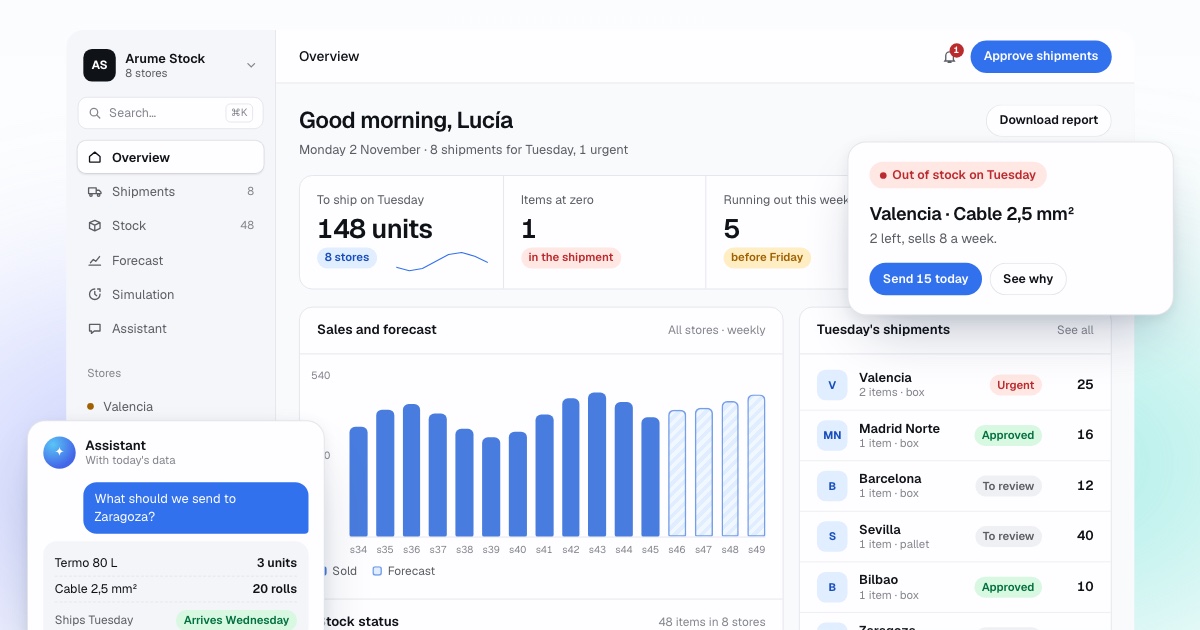
We are not an App Store app. Our inventory control system connects to your Shopify through the API with a read-only user, reads sales and stock for every location and forecasts each product at each location. Every week it proposes what to send, how much and when, with the reason behind each line, and a person approves or changes it. It is built for brands with several stores, warehouses or customers to replenish, usually with their own ERP, or mixing Shopify with other channels, where the replenishment rules do not fit a generic app. See inventory control with Shopify for what it does on top of the platform.
Before you sign, we run a simulation with your data: past dates are replayed with what was known on the day, and what the system would have sent is compared with what you actually did. After that comes one or two months in shadow mode, proposing without anyone using it to decide. Set-up takes three to six weeks. There is a demand forecasting page for how the forecast works, and a AI assistant that answers stock questions and says where each figure comes from.
Who is Arume not for?
If you have one Shopify store and one warehouse, an app from the list above gives you what you need without a project, and there is nothing for us to build. If you manufacture, Katana or an ERP with production has what we lack: bills of materials and factory planning. If all you miss is a place to write purchase orders and email them to suppliers, you do not need forecasting. And if you need something working this afternoon, we are not the answer: our start takes three to six weeks and needs at least a year of sales data.
We cannot guess what is not in the data either. A launch or a promotion you did not record will show up only when it appears in sales, which is why the proposal always passes through a person.
Frequently asked questions
When did Stocky shut down?
According to Shopify’s help centre, Stocky was delisted from the App Store on 2 February 2026 and stopped being available on 31 August 2026, when its APIs also stopped. Read-only access to export data lasts at least 90 days after that date.
What replaces Stocky inside Shopify?
Transfers between locations, purchase orders with receiving, adjustments, stock counts and a history of inventory changes, in the admin and in POS. It does not replace min/max settings or demand forecasting: Shopify points to metafields, reports and the Sidekick assistant.
Can I import my Stocky purchase orders into Shopify?
Historical ones, no. Shopify says a CSV upload carries line items only, without statuses, received quantities or suppliers, and that suppliers cannot be exported from Stocky. Export reports and move supplier details to a spreadsheet while read-only access lasts.
What is the best Stocky alternative?
None wins in every case. With one store and one warehouse, an app such as Stockie or Prediko is enough. With several warehouses and forecasting by location, Inventory Planner or a system like ours. If you manufacture, Katana. If you already run an ERP, ask which tool connects to it.
Do you install from the Shopify App Store?
No. We connect to your Shopify through the API with a read-only user and calculate outside it. That lets us combine Shopify with an ERP or warehouses and write your own replenishment rules, but it means a project of three to six weeks rather than a click.
Can I see the demo in English?
Yes. The only call to action is a 30-minute video demo, in English or Spanish.