Replenishment for distributors: decide each week which outlet gets what, and why.
For distributors that restock their own products in shops, depots or branches, by their own van or by carrier. The system looks at every outlet separately, estimates the risk of running out of each product there and builds the shipment list that pays for itself. You approve the list before anything moves.
Book a 30-minute demoHow it works
Read-only connection · Tested on your own data first · Data hosted in the EU · Demos in English or Spanish
The short answer
Inventory replenishment software for distributors decides every week what to send to each outlet, how much of each product and when. It reads sales and stock from your ERP, estimates what is left at every outlet without anyone counting it, calculates the risk of a stock-out and groups the shipments that are worth making. It suits companies that restock shops, depots or branches. A person approves the list before it goes out, and every line comes with its reason.
By Manuel Gómez González, founder of Arume · Reviewed on
What it does
One forecast per product and per outlet
The same item sells three a week in a shopping-centre store and one a month in a provincial depot. The system learns each product and outlet pair separately and, when an outlet is new or slow, borrows from similar ones (same area, same type of shop) until it has a history of its own.
Shipments that pay for themselves
A box costs the same to send whether it holds two products or twenty. The system checks whether this week's shipment is worth it (sales recovered against transport and stock tied up) and, if it is, fills the box with everything that outlet will need until the next visit.
Stock at the outlet, even when nobody counts it
You know what you sent and what sold. From those two series the system rebuilds the estimated stock of each product at each outlet, day by day, and spots the days when nothing sold because there was nothing to sell. A real count, when someone makes one, corrects the estimate.
Campaigns and countries with their own calendar
A September campaign does not start in the same week in Portugal and in France. The seasonal shape is learned with all outlets of a country together and corrected with the last two weeks of sales. With one campaign of history only, confidence drops and the proposal says so.
The weekly list with the reason on each line
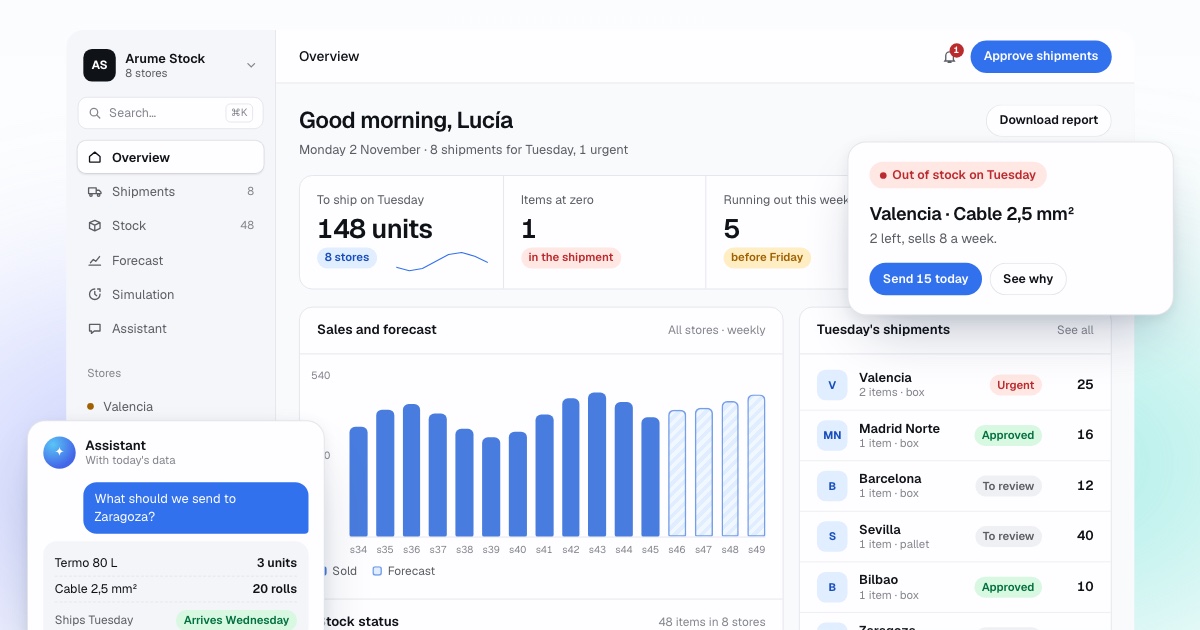
Monday morning, the shipment list ordered by what is lost if it is not sent: outlet, products, units and a sentence such as "sells 4 a week, 3 left, next shipment arrives in 9 days". The person who dispatches approves it, changes what they want and the system learns from those changes.
Central warehouse and supplier in the same calculation
What will go out to the outlets over the next weeks is what the central warehouse must hold. The system adds that demand up and turns it into the purchase order, with the supplier lead time of each product (six weeks if imported, ten days if domestic).
Why is replenishment the hard part for a distributor?
A distributor that restocks its own products in outlets has two stocks: the central warehouse, which is counted, and the one spread over a hundred places, which is not. The difficult decision is rarely how much to buy from the factory. It is whom to send to this week, how much of each reference, and whether a shipment to an outlet that still has something is worth opening.
That decision is usually taken every Monday with last month's sales list, a phone call to the salesperson and a memory of last year. The result is familiar: loud outlets get too much, quiet ones too little, off-season shipments go out on a calendar that did not need them, and when the campaign starts the best outlets run dry for ten days while the box is on the road.
The global out-of-stock study published by FMI, GMA and CIES in 2002 found that around 47 percent of out-of-stocks were caused by inadequate ordering and forecasting at the store. That is the part a distributor does not see from the warehouse, and the part this system tries to reconstruct from the data you already have.
How do you know what is at an outlet nobody counts?
Almost no distributor has daily stock for its outlets. It has delivery notes (what was sent) and, with luck, sales (the customer's sell-out report, the branch till, the van driver's count). With those two series, stock is rebuilt backwards: this much today, this much sold yesterday, a shipment arrived three days ago. It is simple bookkeeping, but nobody keeps it by hand for two hundred outlets and a thousand products.
The reconstruction does two jobs. It tells the system which days an outlet did not sell a product because it had none; without that, the model would learn that the product "does not sell there" and stop sending it. And it shows how much money is tied up in the field, outlet by outlet, which is the figure that surprises people most in the first review.
When a real count exists, it wins and corrects the estimate. The gap between estimated and counted is a signal too: an outlet where stock is always lower than estimated has shrinkage, theft or unreported sales, and it is worth knowing.
Which shipments are worth making and which are not?
A shipment has a fixed cost (carrier, or the van stopping) and a cost for every unit of stock left sitting. Selling one more unit has a margin. The rule is the one a good dispatcher applies in their head: send when what you would lose by waiting is more than the trip costs. The difference is that the system applies it to every outlet and every product, every week, with the forecast and stock-out risk of each.
Two practical effects follow. In the low season shipments are spaced out, because waiting a week costs little. In campaign weeks they get closer, because every day without product at a strong outlet is expensive. And when a shipment does go, it is filled: if the trip is paid for the product that is running out, the other products that outlet will need are added.
- Calendar by country and product family, learned with all outlets together.
- Level of each outlet adjusted with its own sales.
- Correction with the last two weeks, weighted more at the start of a campaign.
- Explicit confidence per line: low where there is only one campaign of history.
What does the system connect to?
It connects read-only to the software you already use: Odoo, Microsoft Dynamics 365 Business Central, Sage, Holded, SAP Business One or an Excel or CSV export per branch. Sell-out reports from retail customers arrive as they are (spreadsheet, PDF, email attachment) and are unified by product and outlet. We set up the connection with a user that can only read.
The approved list comes back as transfer orders or delivery notes in your system, or as a route sheet for the van. Nothing is written without a person approving it. Our approach to ERP integration is described on the page about the AI assistant for ERP.
How does it move from outlet replenishment to the factory order?
The system adds up forecast demand from every outlet over the supplier's lead time (ten days if domestic, six to eight weeks if imported) and turns it into a purchase proposal for the central warehouse, product by product, with the safety stock that matches that lead time and the service level you choose.
That changes a common habit: ordering from the factory with last year's total plus a percentage. When the order comes up from the outlets, you buy more of what is growing and less of what has sat unsold in twenty places. Buying stops being a bet and becomes a sum. The method behind it is explained on the demand forecasting page.
What do you need to provide?
Three things: shipments to each outlet (delivery notes with date, outlet and products), sales or counts for each outlet at whatever frequency exists, and central warehouse stock with its receipts. We take them from wherever they live. In the first review we unify everything by product and outlet and send back a report of what exists, what is missing and which outlets can be trusted.
No personal data is needed. Outlet, product, date and quantity are enough.
How is it tested, and when is it not worth it?
Before you rely on it, the system replays your last campaigns week by week, knowing only what was known on each date, and compares what it would have sent with what you actually sent: demand served, shipments, units and stock left idle. That is the simulation with your data. After it comes one or two months in shadow mode, proposing in parallel while you keep deciding as usual.
It is not worth it with a handful of outlets that a van visits every day: the driver sees the shelf and refills it, and a reorder point in your ERP is enough. Nor without sales history by outlet: with nothing to learn from, the honest step is to start recording it and come back after two campaigns.
Frequently asked questions
I only know what I send and what the outlets sell. Is that enough?
Yes, and it is the usual case. With shipments and sales the system rebuilds estimated stock for each product at each outlet, day by day. When someone counts for real, the count corrects the estimate and you can see where it has been drifting. The first output of the review is how far the estimate can be trusted, outlet by outlet.
My outlets belong to my customers. How do I get their sales?
Most retailers send a weekly or monthly sell-out report, or you note the stock left at each visit. The system works with what exists at the frequency it exists: weekly sales for one customer, monthly counts for another. The review shows which outlets have enough data and which will run with lower confidence.
How does it decide between sending this week and waiting?
It estimates what the outlet would sell until the next possible shipment with the stock it has now, and what would be lost if it ran out of each product. If that loss exceeds the cost of the shipment and of the stock tied up, it sends, and it fills the box. This is why you often see fewer shipments than with a fixed calendar.
Does it replace the local salesperson's knowledge?
No. The salesperson sees a proposal per outlet and approves it or changes it with a note ("a shop is opening next door", "this customer closes in August"). Those reasons are stored and the model learns from them. What changes is that nobody calculates 400 lines in their head.
We sell in several countries with different campaign dates. Can it learn that?
Yes. The seasonal calendar is learned by country, and by area within a country where data allows, and by product family. A country with two campaigns of history gets good confidence, one with a single campaign gets less, and the proposal marks it on each line.
Can we try it before signing?
Yes. We replay your past campaigns and compare the result with what you did, then run one or two months in shadow mode. The only thing we ask first is a 30-minute video demo, in English or Spanish.