Pharmacy inventory: order what you will dispense, not what will expire in the drawer.
For pharmacies with a large range, buying groups and parapharmacy chains with several shops. The system reads sales and stock from your pharmacy management system, calculates what today's wholesaler order needs and what is worth buying direct from the laboratory, and warns you about stock that will expire while it can still be sold or returned.
Book a 30-minute demoHow it works
Read-only connection · Tested on your own data first · Data hosted in the EU · Demos in English or Spanish
The short answer
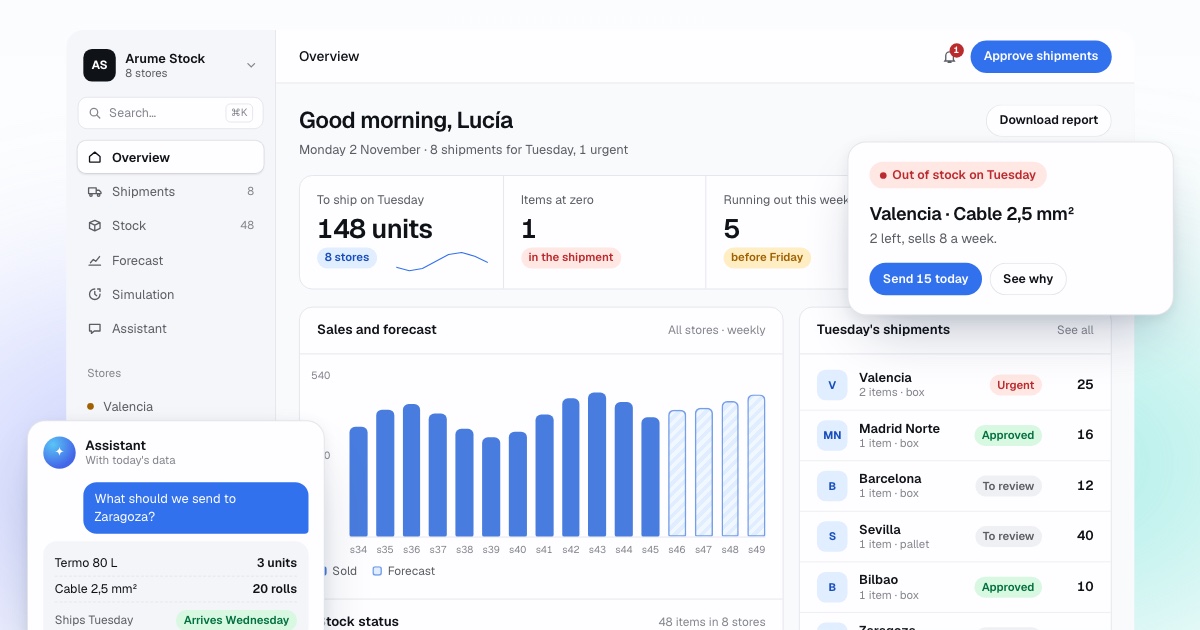
Pharmacy inventory management software calculates each morning what to order from the wholesaler based on what you will dispense, and what is worth buying direct from the manufacturer without it expiring on the shelf. It reads sales, purchases, batches and expiry dates from your pharmacy management system, learns seasons such as allergy or flu, and shows each week what will expire while it can still be sold or returned. It does not use prescriptions or patient data.
By Manuel Gómez González, founder of Arume · Reviewed on
What it does
The wholesaler order, with numbers behind it
The suggested order in most pharmacy systems comes from a minimum and a maximum someone set years ago. Here each product has a forecast for the coming days, counting that the wholesaler delivers within hours, and the morning order proposes what is needed to reach the next delivery at the risk level you accept. Fast movers are ordered often and in small quantities; items that sell twice a month, one box.
Expiry dates seen months ahead
With the batch and expiry date of what comes in and each product's sales pace, the system calculates which units will not sell before they expire. You see them early enough to move them to the front of the display, transfer parapharmacy stock to another shop in the group, or return them within the supplier's window.
Seasons learned: allergy, flu, sun, head lice
Antihistamines start earlier in a dry spring, cold remedies follow each winter's wave, sun care depends on when the heat starts and lice treatments peak at the start of the school year. The model learns that calendar from several years of your sales and corrects it with what is coming through the door now.
Direct purchases without carrying extra boxes
The manufacturer offers terms if you buy volume. The sum nobody does at the counter is how much of that volume will sell before it expires. The system does it with your forecast and the usual shelf life: it shows up to which quantity the discount pays and from which unit you are paying for stock that will be written off.
Stock-out and idle-stock panel
Which products the wholesaler failed to supply this week and how many sales were lost. Which dermocosmetic range has not moved for six months and what it adds up to. Which customer orders are pending. One screen for whoever makes the purchasing decisions.
Parapharmacy with several shops
In a parapharmacy chain the same serum sells in the shopping centre and sits still in the neighbourhood shop. The system forecasts per shop, proposes transfers before buying more and consolidates the purchase from the laboratory into a single order that is then split.
Why is pharmacy stock unlike a shop's?
A pharmacy holds thousands of different products in drawers and on shelves, and most sell little: a box or two a month. A few hundred sell every day. On top of that, the wholesaler replenishes within hours, the manufacturer in days or weeks, almost everything expires, and a good part of counter sales moves with the weather. It is a different replenishment problem from a clothing store or a parts warehouse.
Usually the pharmacy management system handles stock with a minimum and maximum per product. That works while someone reviews them, and normally nobody does: they are set when the product is created, corrected when something runs out and left there. The result shows up in two places: stock-outs at the counter ("I will have it for you this afternoon") and the expired-products bag at the end of each quarter.
The system does the work an assistant with time and a spreadsheet per product would do: look at what sold in recent weeks, where in the year we are, when the next delivery arrives and what expiry date the stock on hand carries. It does it every morning, for the whole range, before the order goes in.
What is the right size for a daily order?
With a wholesaler delivering the same day, the time at risk for a fast-moving product is short: a few hours. The quantity worth ordering is therefore small, just enough to reach the next delivery with a margin. The bigger cushion is kept for products the wholesaler supplies badly or that have a predictable peak.
Slow movers are the other way round: a box sold every three weeks does not need replacing the same day unless there is a customer order. The system separates both groups and for each product calculates how much will be needed until the next delivery, how likely a stock-out is and whether keeping a unit in the drawer is worth it or it is better to order when asked.
- Forecast daily sales of each product, with season and recent sales.
- Real lead time of the wholesaler and of the laboratory for direct purchases.
- Wholesaler shortages: what did not sell because it did not arrive is not counted as low demand.
- Pending customer orders, which go into the order even if the product does not turn over.
How do you see expiries before they reach the drawer?
Expiry is the cost that hurts most in a pharmacy because it is paid twice: you bought it and did not sell it. It tends to appear in the same places: low-turnover dermocosmetics, unusual sizes or formats, items bought in volume for a manufacturer discount, and medicines for a treatment a patient stopped collecting.
With each batch's expiry date and each product's sales pace, the calculation is simple to state and long to do by hand: how many units of this batch will sell before their date? If the answer is fewer than are on hand, the difference is stock to move now. The system does that sum weekly for the whole range and lists the results ordered by value.
If your pharmacy system does not record batch and expiry on receipt, the system can work with the typical shelf life of each product and the order of arrival. It is a coarser estimate, marked as such, but it already shows where money is going.
Does it work with my pharmacy management system?
Pharmacy management systems differ by country, so we do not assume a particular one. If yours can export sales, purchases, stock and, if available, batches and expiry dates to a spreadsheet or CSV, we can read it. If you run an ERP such as Odoo, Microsoft Dynamics 365 Business Central or Sage, we connect to it directly. In every case the connection is read-only: nothing is written to your system until you approve it.
No prescriptions, patient names or histories are loaded. To forecast stock, product code, date, quantity sold, purchases and batch are enough, and we put that in writing.
What does European regulation add?
Medicines in the European Union carry a unique identifier and an anti-tampering device on the outer packaging, under the falsified medicines rules. According to the European Commission, Delegated Regulation (EU) 2016/161 sets out the characteristics of these safety features and how authenticity is verified, and it has applied since 9 February 2019.
That is a regulatory obligation of the pharmacy and its systems, and the stock system does not replace it or certify compliance. What it does is work with the same product and batch data you already record, so that the expiry view is consistent with it. National rules on how a pharmacy buys, stores and dispenses differ from country to country, and you should check them with your own adviser.
Buying groups and parapharmacy chains
When several pharmacies buy together, the joint order to the laboratory is usually built by adding what each owner thinks they will sell. With each pharmacy's sales, that sum comes out calculated, with season and expiry inside, and each pharmacy knows its share before the goods arrive.
In a parapharmacy chain, stock control looks more like a retail chain: the same product turns over in one shop and sits in another, and before buying more it is better to move what is surplus. The system forecasts per shop and proposes transfers in the week's distribution. For prescription medicines this does not apply, because each pharmacy manages its own stock. For the logic, see stock allocation for retail chains.
How is it tested, and when is it not worth it?
The system replays the orders of your last months without knowing the future and compares them with what you ordered: stock-outs at the counter, expired units, money in the drawers and number of order lines. If it does not do better, we say so in the review. If it convinces, one or two months follow in which it proposes every morning and you keep ordering as usual. See the simulation with your data.
A small pharmacy with little parapharmacy, two deliveries a day and no major direct purchasing has little to gain: the time at risk is hours and expiry is controlled with a good review. The honest answer there is to adjust the minimums and maximums in your own system. It pays when there is a lot of dermocosmetics, direct purchases with terms, strong seasons, several pharmacies buying together or several parapharmacies sharing stock.
Frequently asked questions
My system already produces a suggested order. What does this add?
The suggestion in most systems restocks up to a maximum when stock falls below a minimum, and those two numbers are set once and rarely touched. This calculates the quantity every day from recent sales, season, wholesaler lead time and expiry, and tells you why. The result can go back to your system as an order, so the suggestion does not disappear: it improves what goes into it.
How does it know what will expire if I do not record expiry dates?
If your system keeps batch and expiry on receipt, they are read from there. If not, the system works with the usual shelf life of each product and first-in, first-out. It is less precise and it is marked as such, but it already shows which slow products are likely to expire on the shelf.
Does it take wholesaler shortages into account?
Yes. Days when a product did not sell because the wholesaler could not supply it do not count as "does not sell"; otherwise the model would learn to order less of exactly what is scarce. You also see which products fail often, so you can decide whether to hold a bit more of them or source them another way.
I work with two wholesalers. Can it split the order?
It can propose which one to order each line from if you give it the rule: terms of each, delivery cut-off time, which one serves a given product better. Usually we start with your normal rule and the system only calculates quantities. Splitting between wholesalers can come later if it pays.
Can a single pharmacy use it?
It depends on size and on how much expiry and parapharmacy weigh. A pharmacy with plenty of dermocosmetics, direct purchasing and a marked season gets value from it. A neighbourhood pharmacy with two daily deliveries and little parapharmacy probably does not, and we will say so.
What about patient data?
It is not loaded. To forecast stock, product code, date, quantity sold, purchases and batch are enough. Prescriptions, names and histories do not enter the system.